Bob Spooner: One Truck. 60 Years. 8 Million Miles.
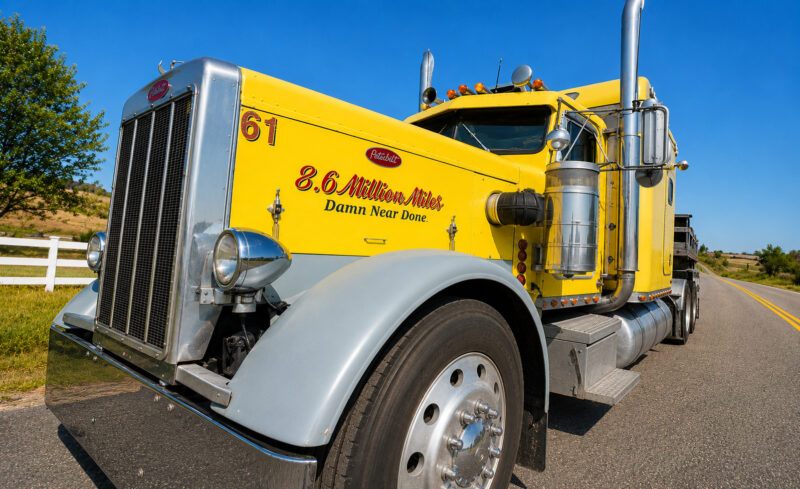
“I’ve had a longer relationship with that old truck than I have anything.”
That one line tells you everything about Bob Spooner.
Not the miles.
Not the decades on the road.
Not the loads that made history.
Just a man, a truck and a bond that outlasted everything else in his life.
Bob Spooner passed away in March 2026, after a long fight following injuries he suffered when he was involved in a wreck on a snow-covered stretch of road on I-80, Christmas Day 2023. The accident took him off the road for good. He was 84.
The trucking world lost something it won’t get back.
Not just a driver, but a living piece of the road itself.
A Runaway Kid Headed West
Bob Spooner grew up in Montgomery, Alabama. When his parents split, he didn’t stay put.
In 1954, after a stop in juvenile hall in San Antonio, he climbed a fence, linked up with another runaway, and kept moving west.
He turned 14 on the way to California, riding a coal-burning freight train that left him filthy within the first 100 miles.
His mother later said he was “a roamer” because he was always gone. That description followed him the rest of his life.
Once he landed in California, he made himself older on paper and got to work.
He landed at Knott’s Berry Farm, where Walter Knott wanted a matched pair of mules and wanted Spooner with them.
The runaway kid from Alabama wound up caring for animals, driving a stagecoach, and learning responsibility long before he ever sat behind the wheel of a truck.
The road to trucking took one more turn first.
After a weekend in jail for getting caught with beer in a car, a judge gave him a choice: California Youth Authority or the military branch of his choosing. He picked the Marines.
Boot camp at Parris Island hit him hard.
He made the rifle team, worked out of the motor pool, and said the Corps taught him right from wrong, even if it didn’t sand away all the rough edges. He served from 1957 to 1959.
When he got out, trucking was waiting.
The Man Who Taught Him to Drive
Spooner didn’t learn to drive in a classroom.
He learned from a guy named Arnold Tipton, a St. Louis driver and a perfectionist who came up in the chain-drive era and had zero patience for shortcuts.
If Spooner ground a gear, Tipton would reach into the doghouse, pull out a short blackjack-style tool he called a “tar-billy,” and rap his knuckles.
There were hard lessons, every day.
But the harder lesson was attention. Tipton would cover the dash gauges with his hand and ask Bob:” What’s the air pressure?” “Where’s the tach?” “What’s the engine speed?” If Spooner didn’t know instantly, Tipton would smack him with the tar-billy.
“There is never a second that goes by that you better not be paying attention.”
That line became the backbone of Spooner’s driving career.
His trainer believed that a driver should know what the engine is doing, where the air pressure is cycling, how the truck feels under load, and what mistake is about to cost money even before it happened.
Those lessons ended one day when Spooner finally snapped.
He pulled the truck over, told Tipton he could drive it better than he could. And then waited.
Tipton just laughed and said he was right.
So that was the end of the beatings and the mutual respect began.
That’s how men learned to drive back then.

The Truck That Cost More Than a House
In September 1960, Spooner walked into a Peterbilt dealership in Los Angeles and saw the truck he wanted.
He asked his employer Bob Eilers if they could get one. Eilers took him down, asked which one, and bought it right on the spot.
It was a single-axle 1961 Peterbilt 281 lightweight. The price? $15,700. Spooner borrowed $500 from his mother to help close the deal.
To put that in perspective: a California house at that time cost around $10,900. So the truck cost more than the house. That’s how serious a bet Spooner was making.
He never let go of it.
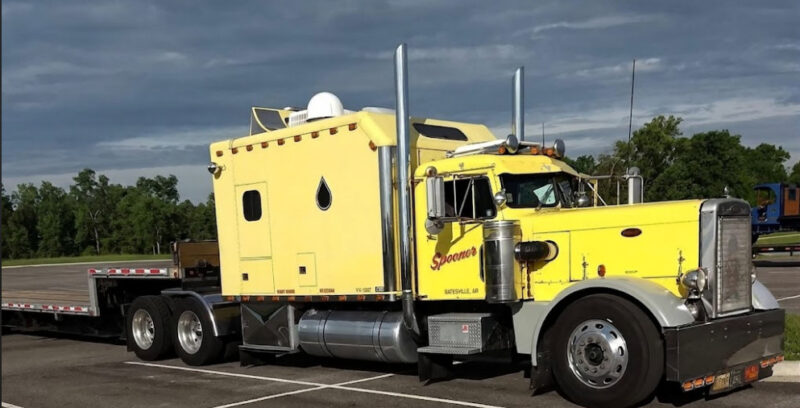
Over 60 years, he upgraded the running gear as was needed …..swapping engines along the way through a hot 335 Cummins, a 475 twin-turbo, a heavy K model twin turbo, a 444, and finally a 2007 electronic Cummins N14 rated at 525 horsepower that he called one of the best engines Cummins ever built.
He added an 18-speed transmission, modern suspension, hub-pilot wheels, and front wheel brakes the truck never originally had.
He kept the Peterbilt alive by maintaining every original part and updating whatever was needed to do the kind of trucking he was doing at the time.
Bob owned several trucks through the years, but this 1961 Peterbilt was the one that Bob hung on to for all of his years of driving.
The Loads That Made History
“It’s hard for me to say what all I’ve hauled. I guess I’ve hauled most everything.”
It didn’t sound like bragging.
It sounded like a man trying to sort through a life too full to keep track.
Spooner Stories
The Apollo program. Spooner hauled parts connected to the Apollo space capsule with armed security riding shotgun from Lancaster, California, all the way to Titusville, Florida. There were escort vehicles, military base overnight stops.
Richard Petty’s No. 43. He hauled the King’s race car to Las Vegas for a show.
The F-35 program. There were parts wrapped so tightly he couldn’t see them. He just drove.
The Hovercraft Car. He hauled 7 Wankel rotary engines….. they could drive down the road and lift off the pavement by 10 – 12 “. He hauled it to an Air Force bases while a test pilot demonstrated it to crowds. The project died because operating it required a helicopter pilot rating. Spooner was one of the few working truckers who ever touched that thing.
The one load he regretted. He hauled a trailer full of salted cowhides straight out from a slaughterhouse. The smell was so bad at a truck stop in Fontana, they asked him to leave before he could even finish his break.
Storms, Tornados, and the Road Turning Ugly
Surviving a Tornado Strike. Near Memphis, headed to a show with his wife and Richard Petty’s car in the trailer, a tornado picked up his truck, stood it on the front bumper, spun it around, and laid it over on its side. The trailer held together. The cargo survived. His wife crawled into the sleeper and covered herself with falling clothes from the closet. Neither of them was hurt.
Saving a Child. On icy Sherman Mountain, he watched a Volkswagen bus get lifted by the wind and rolled around. Inside the VW was a mother and 2 young girls. Spooner stopped, dug them out, got other drivers to help, and then ran hard for Laramie to get the injured child to a hospital. He didn’t talk about it like a heroic act. He talked about it like that’s just what you do.
The Oklahoma Incident. Then there was Oklahoma. His dog Trucker woke him up in the night. Spooner climbed down and found a hose running from another truck to his fuel tank. He confronted the thief, got smacked in the face when the hose snapped loose, lost his temper, and shot the other truck’s fuel tank. The result was a blast of diesel all over him. A state trooper confirmed the hose at the scene and chased the thief instead of throwing the cuffs on Spooner.
He also carried a .45 after the Marines.
Those bullet holes in his truck weren’t decorations.
The Business He Built the Hard Way
By the late 1960’s, Spooner went after his own authority. That meant going to Cincinnati for a hearing before the Interstate Commerce Commission, with major van lines like Atlas, Bekins and North American lined up against him. They argued that his work stepped on theirs.
Spooner’s case was stronger because he wasn’t just hauling displays.
He moved the freight, set up the exhibits, supervised the carpet crews, handled union labour, and stayed with the show. Sometimes, he vacuumed the carpets himself. The customers wanted one person responsible for the whole job. And the judge agreed.
He hauled trade shows for Snap-On for 41 years. He ran Medtronic medical equipment to hospitals and events with 9 trucks of his own. Around 1990, Medtronic was paying him more than $300,000+/annually plus fuel, while those trucks ran fewer than 12,000 miles annually. It was high dollar, specialized work, built solely from reputation.
Like everything in trucking, nothing good lasts forever. When a new Snap-On CEO tried to cut the rates after 40 years of steady work, Spooner walked away.
When brokers started undercutting his Medtronic rates, he sold his trucks, trimmed back, bought a step-deck trailer, and went back to what he always liked best: running the roads by his own rules.
At 74, he was still loading freight, pulling chains, tightening straps, and putting tarps on himself.
“I work every day. I load, I pull chains, I pull straps, I put the tarps on. I do all of what it takes to get a good job done.”
The Code He Lived By
Spooner had a word for drivers who just pointed the hood down the road: steering wheel holders. He used it on purpose, and it wasn’t meant to be funny or flattering in any way.
To him, a real truck driver knows the machine, respects the freight, protects the equipment, and thinks ahead. A steering wheel holder just drives.
He had three things he wanted every young driver to understand:
- Service is what you’re selling. Not miles. Not loads. But service.
- Maintenance keeps you in business. If he thought he heard a strange noise from his truck, he’d wheel it into a rest area, put on coveralls, and check it before going any further.
- Friendships matter more than most people think. When things got heavy for Bob, he called an old road buddy. A conversation about nothing in particular could settle him down faster than anything else.
On weather, his rule was simple:
“If the trucks are piling up everywhere, I park it.”
No delivery appointment was worth rolling the truck. Not even high dollar freight rates were worth freight scattered all over the interstate and a smashed up truck.
He tried retirement once.
It lasted about a year and a half.
He couldn’t stand it. He got back in the truck and went back on the road.
What the Road Cost Him
Long-haul trucking gave Bob Spooner a life most people couldn’t imagine, but it also took a lot in return. A marriage that lasted 40+ years still ended.
But the truck stayed. And the road stayed.
The Man Behind the Miles
Over the past couple of years, the old Peterbilt turned into a full time home on wheels for Bob.
A Double Eagle sleeper built in Shipshewana, Indiana by Amish craftsmen.
Satellite TV. A 15,000-BTU AC and heater setup. A hot water heater, generator, inverter, refrigerator, a large closet, a side compartment for groceries and clothes. He ran a large inverter so he wouldn’t disturb the truck next to him when he fired up the generator unnecessarily. Comfort mattered to him. And so did courtesy.
Spooners shop in Batesville, Arkansas was next door to Mark Martin’s Ford dealership and museum. He never officially gave the Peterbilt a formal name like many truckers do. After 60 years, it was just considered part of the family.
He really loved truck gatherings and events….. with rows and rows of rigs at American Truck Historical Society events, old friends, and the kind of conversation that reminds you why you fell for life on the road in the first place.
There was a video published that brought attention to him. Strangers started recognizing him at Walmart and thanking him for passing along what he knew.
That really mattered to him. He wanted younger drivers to listen while some of the older hands were still around to talk.
He knew those days were running out.
The Road Doesn’t Close
Bob Spooner’s story isn’t unforgettable because the numbers are impressive, even though they are.
One truck. Sixty years. Eight million miles.
It’s unforgettable because the man behind those numbers stayed humble himself all the way through.
He started as a 14 year old runaway on a coal-burning freight train headed west.
Many years later, he was still looking at that big yellow Pete, still throwing chains, still listening to the engine. still going strong.
The road has always had its share of trucks and its share of drivers. But it has never been full of men like Bob Spooner.
Rest easy, Bob.
The road remembers.